The Medieval Villages of the Alt Emporda: Peratallada, Pals, and Pubol
The Emporda plain behind the Costa Brava is the other half of a complete Catalonia journey. This article covers Peratallada, Pals, and Pubol with the architectural context, routing intelligence, and landscape depth that make an inland day from the coast genuinely worthwhile.
Most travelers who visit the Costa Brava spend their days facing the sea. That is understandable. The coves are extraordinary and the coast delivers exactly what it promises. But the landscape behind the coast, the flat agricultural plain of the Emporda with its medieval villages, its rice fields, and its particular quality of interior light, is a different version of Catalonia entirely. One that rewards the traveler who turns away from the water for a day and drives inland.
Peratallada, Pals, and Pubol are the three villages most worth that detour. Each is distinct in character, each connects to the others in a natural geographic sequence, and together they constitute one of the most quietly impressive inland days available from any base on the Costa Brava.
The Emporda Plain: Understanding the Landscape Before You Arrive
Where the coast meets the interior
The Emporda plain sits between the foothills of the Pyrenees to the north and west and the Costa Brava to the east. It is a flat, wide agricultural landscape crossed by the Fluvia and Ter rivers and covered in a patchwork of cereal crops, vineyards, olive groves, and, in the southern Baix Emporda near Pals, rice fields that give the delta a quality closer to the Camargue than to anything else in Catalonia.
The plain is the landscape that Dali painted throughout his life and wrote about with a specificity that makes clear it was not simply a backdrop but a subject. The particular quality of light here, flat and wide and unmediated by the mountain topography that shapes most of Catalonia, gives the interior a visual character that is distinct from both the coast and the Pyrenean foothills.
Why these villages survived intact
The medieval villages of the Emporda survived the twentieth century largely intact for a combination of reasons that have nothing to do with deliberate preservation. The plain's agricultural economy did not generate the kind of development pressure that transformed comparable villages in other parts of Spain. The proximity to the Costa Brava brought visitors but not the residential demand that reshapes village architecture. And the stone from which these villages are built, honey-coloured sandstone and granite depending on the location, does not lend itself to the kind of incremental modification that gradually erodes medieval character elsewhere.
The result is a set of villages that feel continuous with their history in a way that is increasingly rare in Mediterranean Europe, and that reward the kind of slow, attentive visit that most day-tripper itineraries do not allow for.
Peratallada: The Most Complete Medieval Village in Catalonia
What the village actually is
Peratallada is a fortified village built almost entirely in stone, with a street plan that has remained essentially unchanged since the eleventh century. The name derives from the Catalan for carved stone, a reference to the defensive moat cut directly into the rock that surrounds the village on three sides. The castle, the Romanesque church, the arcaded main square, and the network of narrow streets that connect them form a whole that is more coherent and more affecting than any individual element within it.
What distinguishes Peratallada from comparable medieval villages in Catalonia and beyond is the absence of the commercial overlay that typically accompanies this level of heritage recognition. The village has restaurants and a small number of artisan shops, but the proportion of genuinely inhabited stone houses to tourist-facing businesses is high enough to preserve a quality of lived reality that makes the visit feel like an encounter with a place rather than a performance of one.
How to spend time there
Peratallada rewards a minimum of two hours and is best approached without an agenda. The village is small enough to walk entirely in thirty minutes, which means the remaining time can be spent returning to the places that earned a second look: the castle courtyard, the view from the church steps, the stretch of moat that is most legible from the path that runs beside it.
The village is at its best in the early morning before the day-tripper coaches arrive from Barcelona, or in the late afternoon when the light on the stone takes on a warmth that the midday sun flattens. Arriving at eleven and leaving at one captures neither quality. Arriving at nine or returning after four captures both.
Eating in Peratallada
Peratallada has a concentration of restaurants that is disproportionate to its size, and several of them are genuinely worth planning around rather than treating as a convenient lunch stop. The cooking draws on the inland Catalan tradition of the Emporda: slow-cooked meat dishes, seasonal vegetables from the surrounding plain, and the kind of rice preparations that reflect the proximity of the delta to the south. Eating in the village square on a warm evening, if the itinerary allows, is one of the more complete sensory experiences the Emporda interior offers.
Pals: Gothic Quarter, Rice Fields, and a View Worth Timing
The Gothic quarter and the tower
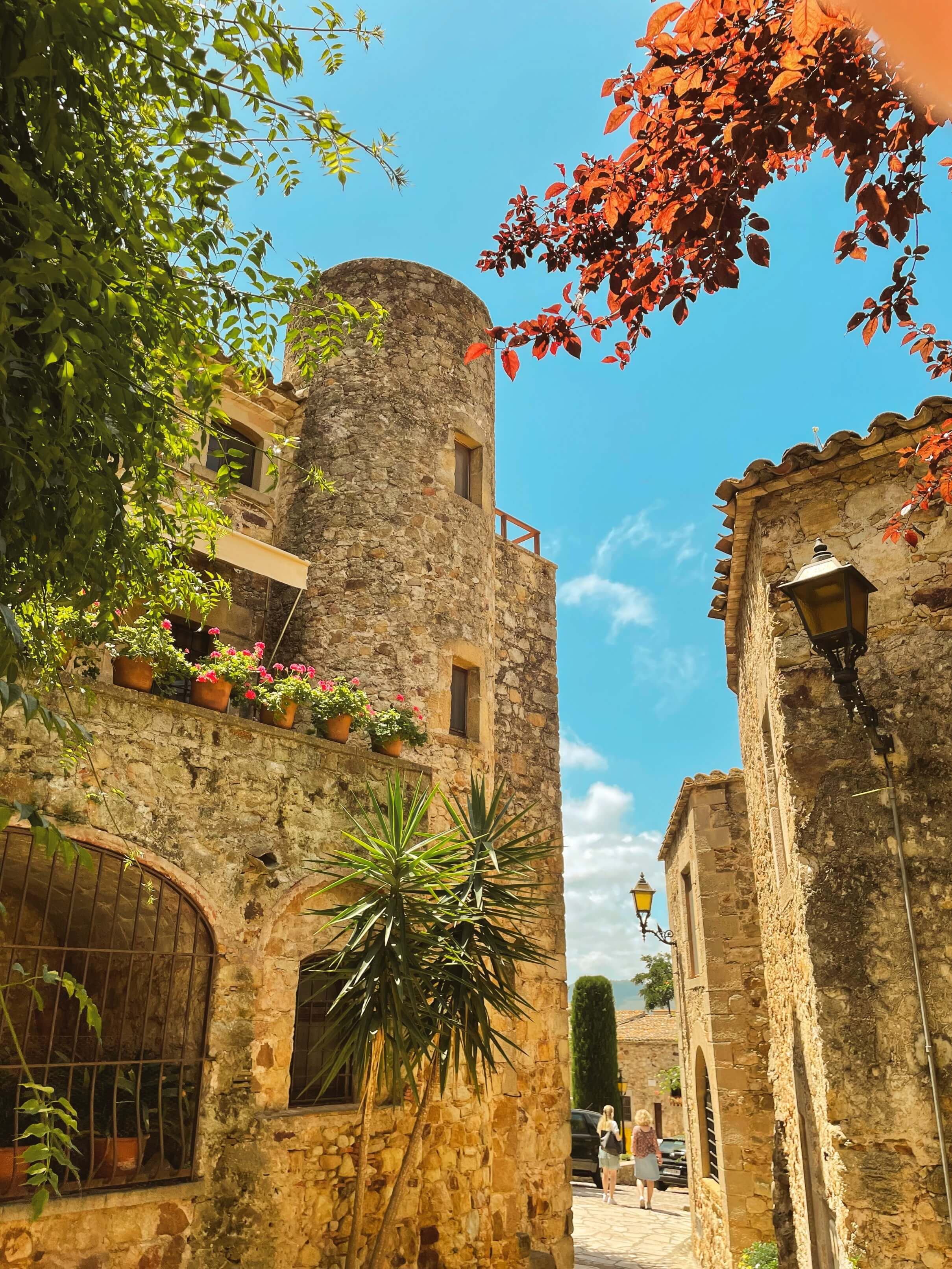
Pals sits on a low hill above the Emporda plain approximately fifteen minutes by car from Peratallada. The Gothic quarter at the top of the hill is more compact than Peratallada and more dramatically positioned, with the cylindrical Torre de les Hores, a fourteenth-century watchtower, rising above the roofline at the village's highest point. The views from the tower and from the walls around it extend on a clear day across the rice fields of the delta to the sea, and on a very clear day to the Medes Islands offshore.
The village below the Gothic quarter is partially restored and partially inhabited, with a quality of incompleteness that is less uniform than Peratallada but in some respects more interesting: the evidence of how a medieval village actually changes across centuries is more legible here than in a village that reads as entirely preserved.
The rice fields of the Emporda delta
The rice fields that surround Pals to the south and east are one of the more unexpected landscapes in Catalonia. The flat, reflective paddies extend toward the coast in a way that changes the visual register of the Emporda plain entirely, giving this part of the interior a quality that has more in common with the river deltas of Valencia or the Camargue than with the dry agricultural landscape of most of northeast Spain.
The rice grown here is the basis for the arros a la cassola and other rice dishes that appear on menus throughout the Baix Emporda. Visiting the fields in summer, when the paddies are full and the light reflects off the water surface, gives the detour a visual reward that the village alone does not fully anticipate.
How Pals differs from Peratallada
Peratallada is more complete, more uniformly medieval, and more immediately impressive as an architectural whole. Pals is more layered, more dramatically positioned, and more interesting as a landscape proposition when the rice fields and the view from the tower are factored in. For a traveler who can visit only one, architecture and coherence points to Peratallada. Landscape and dramatic position points to Pals. A half day that includes both, in that sequence, covers the full register of what the Emporda interior offers at its best.
Pubol: The Castle, the Village, and the Dali Connection
The village itself
Pubol is a small village in the Baix Emporda, smaller and quieter than either Peratallada or Pals, and less immediately legible as a destination in its own right. The village has a Romanesque church, a compact central square, and the kind of unhurried local character that the more visited villages of the interior have partially lost. It sits within the flat plain between Pals and La Bisbal d'Emporda, and the surrounding landscape of cereal fields and scattered farmsteads gives it a quality of agricultural ordinariness that makes the castle within it all the more surprising.
The castle and its significance
The castle of Pubol is the third point of the Dali Triangle, the medieval structure that Salvador Dali acquired in the late 1960s and restored as a gift for his wife and muse Gala. The restoration is meticulous and personal, with Dali's hand visible in every room: the trompe l'oeil ceilings, the elephant sculptures in the garden, the preserved intimacy of Gala's private spaces. It is the quietest and most formally restrained of the three Dali sites, and it rewards the kind of unhurried attention that the larger Theatre-Museum in Figueres does not always make easy.
What makes Pubol particularly interesting within an inland village itinerary is the contrast it creates with Peratallada and Pals. Where those villages are legible through their architecture and their relationship to the agricultural landscape, Pubol is legible through the specific and unusual story of two people and the particular dynamic of their relationship, expressed in stone and garden and the surreal logic of the rooms Dali designed for someone he loved on terms that were entirely his own.
How Pubol connects to the wider Dali landscape
Pubol is covered in full, alongside Portlligat and the Theatre-Museum in Figueres, in our guide to the Dali Triangle. For travelers with a serious interest in Dali's work and life, that article covers the sequencing, cultural context, and practical logistics of visiting all three sites. For travelers approaching Pubol primarily as a village within an inland Emporda day, the castle visit adds a cultural dimension to what is otherwise a landscape and architecture itinerary, and it does so in a way that requires no prior knowledge of the work to be affecting.
Designing an Inland Day: Routing and Sequencing
The case for visiting all three in one day
All three villages are physically possible in a single day from any base on the Costa Brava. The total driving time between Peratallada, Pals, and Pubol is under thirty minutes, and each village can be explored thoroughly in two hours or less. A day that departs a coastal base by nine in the morning, visits Peratallada and Pals before lunch, eats in Peratallada or at a restaurant in the plain between the villages, visits Pubol in the early afternoon, and returns to the coast before evening is entirely manageable and internally coherent.
The risk with three villages in one day is the temptation to move too quickly through each. Two hours in Peratallada is the minimum for the village to give what it has. Less than that produces an impression rather than an experience.
Suggested sequence and practical notes
The most effective sequence is Peratallada first, Pals second, and Pubol last. This moves from the most architecturally complete village to the most dramatically positioned, and concludes with the most culturally specific, giving the day a satisfying arc rather than a list of stops.
Peratallada and Pals have no entrance fees for the villages themselves and no booking requirements. The castle at Pubol requires a ticket and benefits from checking opening times before the visit, as hours vary by season. La Bisbal d'Emporda, ten minutes from Pubol, is a practical lunch alternative for those who prefer a town setting, and its ceramics street is worth a short walk before or after.
The inland villages are accessible by car from any base on the Costa Brava in under forty minutes. From Cadaques the drive takes approximately an hour. From Begur the drive is thirty minutes and passes directly through the Baix Emporda landscape that surrounds the villages.
How the Interior Connects to a Costa Brava Journey
The Emporda interior is not a distraction from a Costa Brava journey. It is the other half of it. The coast and the plain are the same landscape viewed from different perspectives, and a week that includes both is a more complete account of what this part of Catalonia actually is than one that stays on the water.
For travelers based in Begur and the Baix Emporda, the medieval villages sit within thirty minutes and connect naturally to an itinerary that already balances coves, coastal walks, and good food. Our guide to Begur and the Baix Emporda covers how to integrate the inland villages into a week on the central coast. For travelers based in Cadaques or driving the full length of the coast, the villages work best as a dedicated inland day built into the routing southward, as covered in our guide to driving the Costa Brava.
FAQs
Is Peratallada worth visiting?
Yes, without qualification. It is the most complete and coherent medieval village in Catalonia and one of the most impressive in Spain. It rewards a minimum of two hours and is best visited early in the morning or late in the afternoon to avoid the midday coach groups and to experience the stone at its most visually rewarding.
How far are the medieval villages from the Costa Brava?
Can you visit Peratallada, Pals, and Pubol in one day?
What is the difference between Peratallada and Pals?
Do you need to book to visit these villages?
What is the best time of year to visit the Emporda interior villages?
Design Your Emporda Interior Day
The medieval villages of the Alt Emporda reward careful planning and the right amount of time in each place. Contact us to discuss how we integrate the interior into a wider Costa Brava or Catalonia journey.
Latest posts

The 2030 World Cup is coming to Spain, Portugal, and Morocco
In 2030 the World Cup comes to Spain, Portugal, and Morocco. Our travel coordinator Pedro Contreras Gonzalez, who has spent over twenty years in hospitality across Spain and the UK, on what has been confirmed, what has not, and what it means for anyone thinking about being there.
Read more

How to design a week in northern Morocco around the 2027 solar eclipse
A week in northern Morocco built around the 2027 solar eclipse combines Tangier, the blue city of Chefchaouen, and Tetouan's UNESCO medina for eclipse day, where four minutes and fifty-three seconds of totality will descend on one of the most culturally extraordinary cities in North Africa.
Read more

How to design a week in Andalusia around the 2027 solar eclipse
A week in Andalusia built around the 2027 solar eclipse covers Seville, Ronda, the Sierra de Grazalema, and Marbella for eclipse day, with enough time to experience one of the great destinations in southern Europe alongside one of the most extraordinary astronomical events of a lifetime.
Read more