Driving the Costa Brava: A Considered Self-Drive Route from Barcelona
The Costa Brava stretches 200 kilometers from Blanes to the French border, and its most rewarding qualities are accessible only by car. This guide covers the full self-drive route from Barcelona north, with the routing intelligence, road conditions, and cultural context that a well-designed journey requires.
The Costa Brava stretches roughly 200 kilometers from Blanes in the south to Portbou at the French border, and its character shifts so significantly along that length that a traveler who stays in one place will understand only one version of it. A car changes that entirely. It turns the Costa Brava from a destination into a journey, and a journey with enough variation in landscape, culture, and pace to sustain a week of serious attention.
Why the Costa Brava Rewards a Road Trip
A coast that only makes sense at your own pace
The roads that connect the most interesting parts of the coast are often narrow, occasionally demanding, and rarely direct. That is precisely what makes them worth driving. The GI-682, which runs along the cliffs between Sant Feliu de Guíxols and Begur, is one of the most rewarding coastal roads in Spain. The final approach to Cadaqués over the Serra de Rodes is an experience that no summary can fully prepare you for.
A self-drive route also allows the kind of spontaneous decision-making the coast rewards. A sign for a cala you did not plan for. A village that warrants an unscheduled stop. A restaurant on a terrace above the sea where lunch extends without consequence. A car accommodates all of that. Public transport cannot.
What a car unlocks that other travel cannot
The most significant things the Costa Brava offers, the remote coves, the medieval villages of the Empordà interior, the Cap de Creus headland, the small fishing ports outside any tourist circuit, are accessible only by car. For couples designing a journey that prioritises depth over coverage, the car becomes an instrument of that design rather than a logistical necessity. You move when you are ready, stop when something earns it, and arrive at the next place with enough context from the road to understand why it sits where it does.
Before You Leave: What to Know About Driving in Catalonia
Roads, conditions, and seasonal considerations
The AP-7 toll motorway runs parallel to the coast from Barcelona to the French border and is the fastest route between any two points. It is not the interesting route. The coastal roads, particularly the GI-682 and the secondary roads connecting the coves and villages of the Baix and Alt Empordà, are where the journey happens.
In summer, traffic on coastal roads between Palamós and Begur slows on Friday afternoons and Sunday evenings. The road into Cadaqués from Roses becomes congested in July and August between midday and early evening. Arriving before ten in the morning or after eight at night resolves most of the problem. The tramuntana, the strong north wind of the Alt Empordà, does not affect driving significantly but makes certain exposed stretches feel dramatic.
Renting a car and where to pick up
Barcelona El Prat Airport and Barcelona Sants train station are both practical collection points for travelers starting from the south. Girona Airport and Girona train station suit travelers flying in directly and beginning the route at the midpoint. A standard car handles all roads on this route comfortably. A larger vehicle becomes a disadvantage on the narrower coastal roads and in the older towns. An automatic transmission is a sensible choice for drivers less experienced with mountain roads.
The Route, Stretch by Stretch
Barcelona to Blanes: leaving the city behind
The most practical exit north follows the C-32 coastal motorway before joining the AP-7 near Malgrat de Mar. Blanes, the official southern boundary of the Costa Brava, sits approximately an hour from central Barcelona. It is a working town with a large beach and a botanical garden worth a short stop. The coast begins to earn its name further north, once the road climbs into the headlands above Tossa de Mar.
Blanes to Begur: the southern Costa Brava
Tossa de Mar is the first town on the route with the quality of light and landscape that defines the coast. The medieval walled village above the bay is one of the best-preserved on the Costa Brava, and the beach below retains its character despite summer volumes. It merits a stop of at least a couple of hours.
From Tossa, the GI-682 runs north along the clifftop toward Sant Feliu de Guíxols: twenty-one kilometers of curves above the sea, with views down into coves accessible only on foot or by boat. Sant Feliu has a good market and a waterfront with more local character than many comparable Costa Brava towns. Palamós, further north, is the region's most significant fishing port and the source of the red prawns that appear on menus across Catalonia.
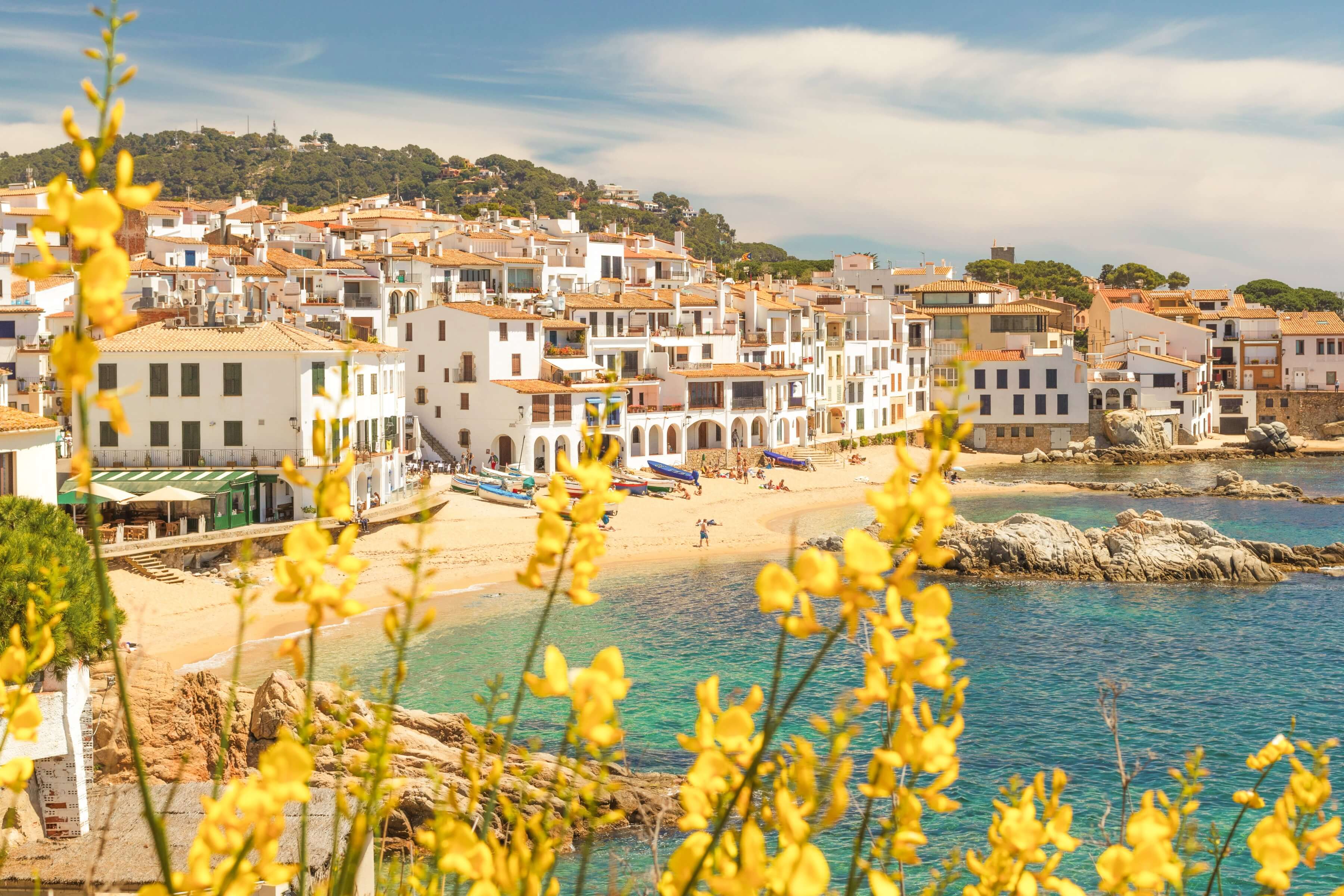
Calella de Palafrugell, Tamariu, and Aiguablava represent the central coast at its most considered. Begur, set on a hill above this stretch with a ruined castle and restaurants that punch above their geographic weight, is the natural base for the area and a strong overnight stop.
Begur to Girona: the inland detour worth making
The route inland toward Girona passes through the Empordà plain and several medieval villages worth a deliberate stop. Peratallada, entirely preserved in stone and largely free of commercial overlay, is the most impressive. Pals, with its Gothic quarter and views over the plain, is fifteen minutes away.
Girona itself rewards an overnight stay. The old town contains a cathedral, a well-preserved Jewish quarter, a Roman wall, and a level of culinary ambition that reflects the city's position at the center of one of Spain's most significant gastronomic regions. It sits at the geographic midpoint of the route and makes a natural pivot between the southern and northern Costa Brava.
Girona to Figueres: the cultural corridor
The drive from Girona to Figueres follows the AP-7 north for approximately forty minutes across the Empordà plain. Figueres warrants a stop of at least half a day for the Dalí Theatre-Museum, a building that rewards patience and a willingness to move slowly through its spaces. For travelers with a serious interest in Dalí's work, our guide to the Dalí Triangle covers the sequencing, timing, and cultural context for visiting all three sites in full.
Figueres to Cadaqués: the road that earns its destination
From Figueres, the GI-614 runs east toward Roses. The road from Roses to Cadaqués climbs over the Serra de Rodes through twenty kilometers of tight bends with views that expand with every meter of elevation. It is one of the more memorable driving approaches in Spain. The town appears below as the road crests the final rise, white against the hillside, the bay almost perfectly still.
Cadaqués merits a stay of at least three nights. It is the natural culmination of the route, and it rewards the traveler who arrives with enough time to let it settle. Our guide to slow travel on the Costa Brava covers the town, the Cap de Creus peninsula, and how to spend that time well.
Cadaqués to the French border: the quiet northern end
El Port de la Selva, a fishing village on the western side of the Cap de Creus peninsula, is worth the detour for travelers with an extra half day. The monastery of Sant Pere de Rodes, perched on the hillside above the plain with views to the sea, is one of the most significant Romanesque buildings in Catalonia. Llançà is a quiet coastal town with good beaches and a local character the more celebrated towns have largely lost. Portbou, at the border, is historically significant as the town where Walter Benjamin died in 1940. The Dani Karavan memorial installation set into the cliffside above the sea is among the most affecting pieces of public art on the entire coast.
How Many Days Does the Route Need?
Five days covers the route at a minimum, with one overnight in the Baix Empordà, one in Girona, and two in Cadaqués. It is tight and every stop will feel abbreviated.
Seven days is the considered version. Two nights in the Begur area. One in Girona. One near Figueres for the Dalí Triangle. Three in Cadaqués. This is the structure the route actually requires, and it is the version worth building an itinerary around.
The risk with a route this rich is over-scheduling. Each addition is individually justifiable and collectively corrosive to the pacing that makes a road trip feel designed rather than accumulated. The discipline is knowing which stops earn their place and which ones push others out.
Practical Notes for the Road
Parking is the most consistently underestimated challenge of driving the Costa Brava in summer. The older towns were built before the car and accommodate it reluctantly. Municipal car parks fill early and do not empty until evening. Arriving before ten or after six makes a material difference in every town on the route. In Cadaqués specifically, accommodation with parking or a confirmed reservation is worth prioritising.
The route is well suited to multigenerational groups with appropriate planning. The mountain approach to Cadaqués and the cliff road between Tossa and Sant Feliu require comfort with narrow, winding conditions. Breaking the final approach to Cadaqués with a stop in Roses is worth considering for groups traveling with older members.
FAQs
How long does it take to drive the full Costa Brava?
As a continuous drive on the motorway, three to four hours from Barcelona to Portbou. As a journey with stops and time at the places that earn it, a minimum of five days and ideally seven.
Is driving the Costa Brava difficult?
Do you need a car to explore the Costa Brava?
What is the best time of year to drive the Costa Brava?
Is the AP-7 toll motorway worth using?
Design Your Costa Brava Road Trip
The Costa Brava rewards careful routing and the right amount of time in the right places. Contact us to discuss how we design self-drive journeys along this coast, from the first stop south of Barcelona to the final road into Cadaqués.
Latest posts

The 2030 World Cup is coming to Spain, Portugal, and Morocco
In 2030 the World Cup comes to Spain, Portugal, and Morocco. Our travel coordinator Pedro Contreras Gonzalez, who has spent over twenty years in hospitality across Spain and the UK, on what has been confirmed, what has not, and what it means for anyone thinking about being there.
Read more

How to design a week in northern Morocco around the 2027 solar eclipse
A week in northern Morocco built around the 2027 solar eclipse combines Tangier, the blue city of Chefchaouen, and Tetouan's UNESCO medina for eclipse day, where four minutes and fifty-three seconds of totality will descend on one of the most culturally extraordinary cities in North Africa.
Read more

How to design a week in Andalusia around the 2027 solar eclipse
A week in Andalusia built around the 2027 solar eclipse covers Seville, Ronda, the Sierra de Grazalema, and Marbella for eclipse day, with enough time to experience one of the great destinations in southern Europe alongside one of the most extraordinary astronomical events of a lifetime.
Read more