Valencia With Kids: The City I Explored With Two Toddlers
A first-hand guide to Valencia with kids, built around the Turia, markets, Fallas culture, and a day in Albufera where Paella Valenciana truly starts.
By Magdalena Kerestegian | March 31, 2026
I moved to Valencia almost four years ago with two kids. That is how I learned this city. Not through late dinners and long museum days, but through stroller routes, shade strategies, playground reconnaissance, and the small negotiations that happen when you want a place to feel like a trip without turning it into an endurance test.
At first, I explored like a tourist. Then Valencia became home. Somewhere in the middle, it became something even more useful: a city I understood as a system. Valencia rewards you when you plan around how families actually move, not around what a guidebook says you should do.
Valencia also sits in a geography that quietly shapes everything. The huerta wraps around the city, still defined by historic irrigation institutions and canal networks that have managed water here for centuries. The Mediterranean sits to the east, and it shows up in the way seafood threads through local cooking and market life. South of the city, Albufera’s wetlands and rice fields anchor the food story that most visitors come looking for, whether they realize it or not: paella.
In Valencia, the best “attraction” is the space between attractions
If you take one idea from this guide, let it be this. Valencia is not at its best when you sprint between highlights. It is at its best when you leave room for the city itself. The plazas, the lingering lunches, the park time, the bike ride, the moment when the day resets and everyone’s mood comes back online.
That is why Valencia works so well for families. It has plenty to do, but it does not demand constant doing.
The Turia: Valencia’s family backbone
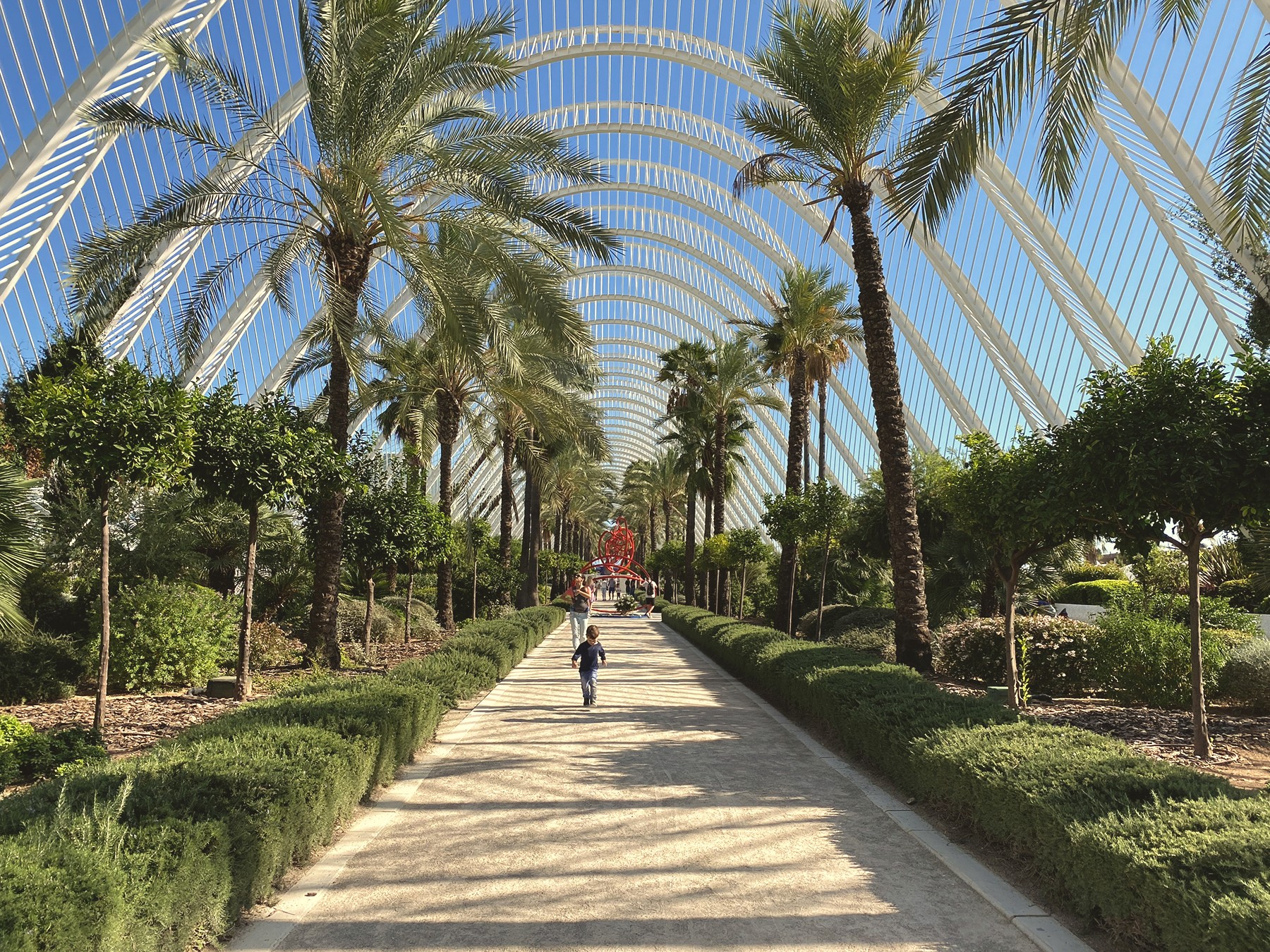
The Jardín del Turia is the reason Valencia feels easy with kids. It runs for more than nine kilometers through the city along the former riverbed, after the Turia was diverted south following the devastating floods of 1957.
People call it a park, but it behaves like a living corridor. It is an escape from the city in the heart of the city, full of vegetation, sports areas, and playgrounds that appear right when you need them. It is also one of the best places in Valencia to bike as a family, because you can move for long stretches away from traffic and let kids ride at their own pace.
One reason the Turia works so well for families is that it begins and ends in places that are already family-friendly.
At the western end, Cabecera Park is a natural starting point, and Bioparc València, a beautiful zoo, sits right there as a high-reward outing, especially for younger children. At the eastern end, the Turia leads toward the City of Arts and Sciences, Valencia’s modern icon.
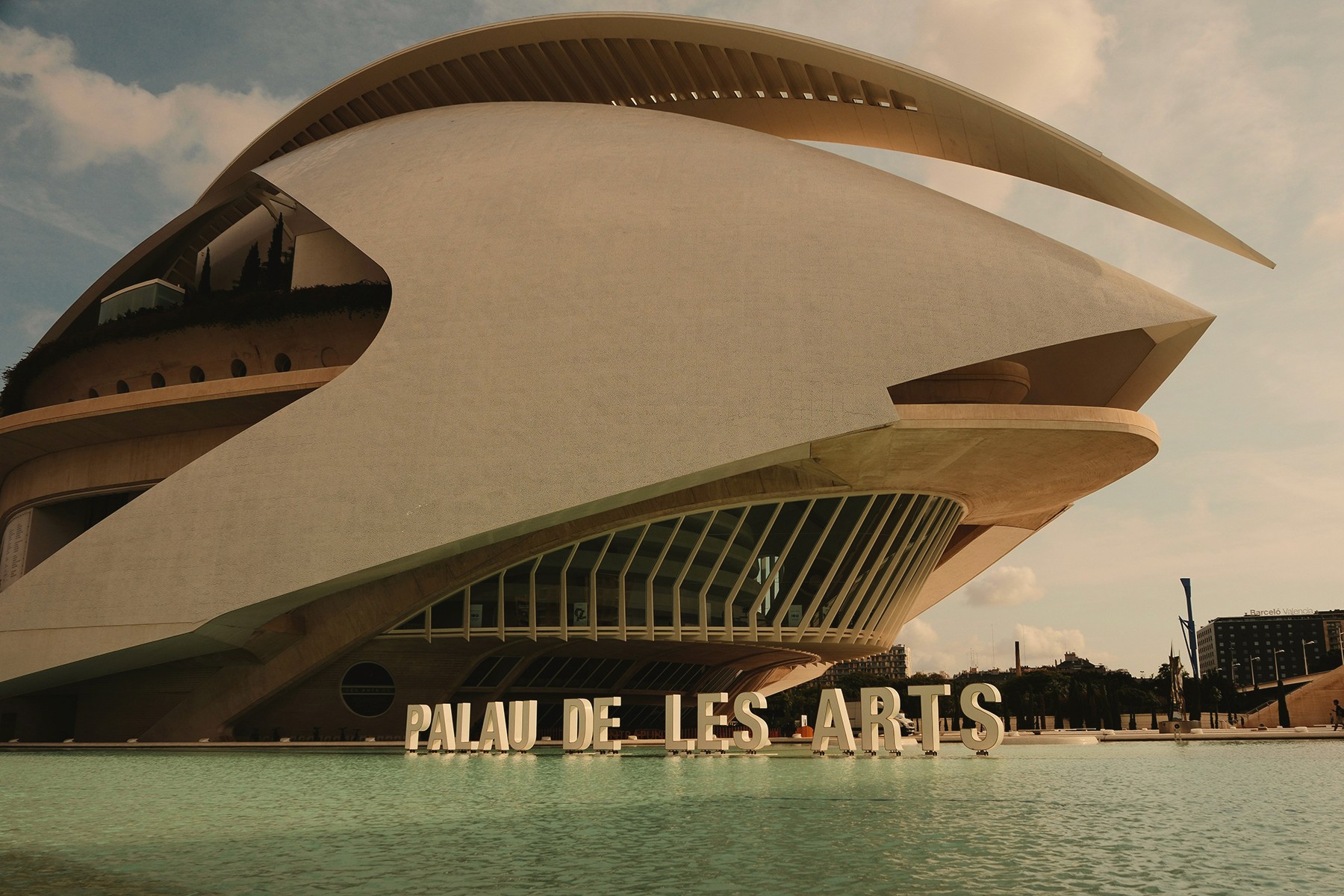
And that icon is not an accident of urban development. The City of Arts and Sciences was designed by Santiago Calatrava, a Valencian architect with global recognition, and the complex sits in the former Turia riverbed.
Some say the Turia “put Valencia on the map.” It is not just a pleasant park. It is the spine that links the old city, modern Valencia, and the long-term story of how the city reimagined itself.
A big city with a pueblo rhythm
Valencia is Spain’s third-largest city, which means it has what a major city should have: serious dining, museums, shopping, and the infrastructure families quietly rely on.
But Valencia still holds onto a pueblo rhythm. There are long-running Spanish bars that exist because they always have, not because they were branded for visitors. Lunch still matters. A pause still exists in the day. People linger. For families, that tempo is not a detail. It is the advantage.
Fallas: Valencia at full volume
Valencians are intensely proud of Fallas, and it makes sense why. It is officially recognized by UNESCO as Intangible Cultural Heritage of Humanity.
If you are planning around Las Fallas, it helps to separate the festival from its signature events. During the festival, the mascletà, a daytime firecracker concert focused on rhythm and sound, happens daily from March 1 to March 19, with the most immersive stretch of Fallas concentrated in March 15 to March 19. The fire comes at the end with La Cremà on March 19, when the monuments across the city are burned in a single, unforgettable finale.
Fallas is craft and satire and neighborhood pride, built into monuments that appear across the city like a temporary outdoor museum. There is music, procession, and the strange magic of watching something that took immense labor and artistry exist for a brief moment in time.
And then there is fire.
Fire in Valencia is not something you run away from. You observe it. You take it in. You watch these week-old monuments burn, and you understand that the ending is part of the point. It makes space for the next year, the next idea, the next beginning.
Fallas is also intense. It is loud in a way no paragraph can translate. There are crowds. There are long days and nights that blur together. Some visitors are completely enchanted. Others feel overwhelmed. The truth is that no one can fully explain what Fallas is like. You can only experience it.
If you are traveling as a family, the best approach is to experience Fallas in focused windows rather than trying to live inside it nonstop. Valencia will give you the magic either way. The difference is whether everyone still has energy left to enjoy it.
Mercado Central: a stunning stop, even if you only grab lunch
Mercado Central is worth a stop even if you are not “a market person.” It is a stunning building, and it offers a fast, sensory introduction to Valencia’s everyday life. It is also one of those practical details that matters, especially with kids: it is open Monday through Saturday and closes at 3:00 pm.
The products are beautiful. Some stalls are priced for visitors. That goes without saying. But it is still worth it. Even if you only buy lunch on the go and eat it elsewhere, you will be glad you went.
My must-stop is the olives and gildas. If you do nothing else, do that. Grab a few favorites, add fruit, maybe something simple for the kids, and build a picnic that you can eat in the Turia.
If you have older kids, add one more stop inside the market: Bar Central. It is Ricard Camarena’s bar inside Mercado Central, and it runs on a very Valencia principle. No reservations. You wait in line. You eat well.
Gulliver Park: pure joy, best with a plan
Gulliver Park is one of the most joyful things Valencia offers families. Kids love it instantly. Adults usually end up laughing too, because it is impossible not to.
It is also more climbing than strolling. So it works best when your group has at least a few adults who are happy to be on the move, while others relax nearby. If you have grandparents who prefer a calmer pace, treat Gulliver as a split moment, not a full-group requirement. That is the Valencia family rhythm in a nutshell. Together, then optional, then together again.
It is 100% fun and, as every Valencia parent knows, a little bit of chaos. I wouldn’t miss it.
City of Arts and Sciences: a highlight, if you do it with restraint
The City of Arts and Sciences is Valencia’s modern icon, and it can be a highlight for families if you treat it like a well-paced outing, not a checklist. The architecture is part of the experience. Santiago Calatrava designed the complex, and you feel that sense of scale and drama the moment you arrive.
Here’s the key: choose one main “anchor” inside the complex, then let the rest of the time be open air and flexible. This is where families go wrong. They try to stack Oceanogràfic, the Science Museum, and everything else into one long push. It sounds efficient. In real life, it is how you end up with tired feet, cranky kids, and grandparents counting the minutes.
If you pick one thing, pick Oceanogràfic
Oceanogràfic is the easiest family win. It has momentum. Kids stay engaged because it is visual and constantly changing, and adults tend to enjoy it more than they expect. It is also large, so the pacing matters.
What works well:
Arrive earlier, before the day heats up and before the crowds peak.
Commit to a few zones, not every corner. You do not need to “complete” it.
Build in a reset: a slow snack, a sit-down moment, or a quiet pause outside before you decide what is next.
The Science Museum is best for older kids
If your kids are older, or you have teens who like hands-on exhibits, the Science Museum can be a better fit than another long walk through tanks and tunnels. The key is the same: pick a focus, give it a clear time window, then stop before it becomes too much.
The best pacing move is what you do after
The best part of visiting the City of Arts and Sciences is that you do not need to force more “attractions” afterward. This is where Valencia’s rhythm matters. Leave room for the space between things.
A great family flow looks like this:
Morning at Oceanogràfic (or the Science Museum), done intentionally, not exhaustively.
Long lunch.
A slow walk back through open air.
Then either a Turia reset or a calm evening plan.
The beach truth
Valencia has beaches, but I would not describe it as a beach destination. Spain has coastlines with more dramatic scenery and more “vacation beach” energy.
What Valencia’s beach does offer is something different, and very useful on a family trip. It is a reset. It is air and space when you need a break from the city. It is the feeling of the Mediterranean being right there, close enough to soften the edges of a busy itinerary.
Plan Valencia as a city first. Then use the sea as the pressure valve.
Albufera and the origin of Paella Valenciana
This is non-negotiable. Paella originates here, in the Valencia region, tied to rice cultivation and the landscapes around Albufera.
If you want the version of Valencia that feels most grounded, go to Albufera. Boat time works across generations. The landscape feels different from the city in the best way. And the food story clicks.
One of my favorite Valencia memories is eating paella on a terrace while trucks moved rice from the fields to nearby facilities. It felt like true ground zero. Not a staged experience. Just real life happening next to your plate.
Paella Valenciana, and what it actually is
When locals say “the original,” they mean Paella Valenciana. Spain’s official tourism site lists the classic ingredient set that defines it: short-grain rice, chicken, rabbit, tomato, green beans, garrofó beans, olive oil, saffron, paprika, water, and salt, with some optional elements depending on tradition.
It also helps to explain one language detail that visitors often miss.
Paella is specific. Arroz is the broader category. Valencia has many rice dishes, and they are not “alternatives to paella.” They are their own world. Understanding that distinction helps travelers order well and appreciate what they are eating.
How I pace a family day in Valencia
Valencia days go best when they have one clear anchor and plenty of oxygen around it. The city has enough texture that you do not need to stack highlights to feel like you experienced it.
A structure that works across generations is simple:
Start with one focused visit early.
Reset in the Turia.
Do a long lunch.
Keep the afternoon flexible.
End with an easy evening.
That is how Valencia wants to be experienced. It is also how families stay happy.
Valencia is not a city you conquer. It is a city you settle into. It has the substance of a major Spanish city, but it still moves with a rhythm that makes families feel held. If you give Valencia room, it gives you the kind of trip people remember for how it felt, not just what they saw.
FAQs
What is the single best family “hack” in Valencia?
Plan around the Jardín del Turia. It is the city’s backbone for walking, biking, playground breaks, and resetting the day.
What time does Mercado Central close?
Is Fallas worth seeing?
Where does paella originate?
Is Bar Central in Mercado Central reservation-only?
What’s the best time of year to visit Valencia with kids?
Design Your Family Trip
If Valencia is on your list for a multigenerational journey, we can help shape the pacing, neighborhoods, and day flow so the city feels grounded, calm, and distinctly Valencian.
Latest posts

How to design a week in northern Morocco around the 2027 solar eclipse
A week in northern Morocco built around the 2027 solar eclipse combines Tangier, the blue city of Chefchaouen, and Tetouan's UNESCO medina for eclipse day, where four minutes and fifty-three seconds of totality will descend on one of the most culturally extraordinary cities in North Africa.
GET RESOURCES

How to design a week in Andalusia around the 2027 solar eclipse
A week in Andalusia built around the 2027 solar eclipse covers Seville, Ronda, the Sierra de Grazalema, and Marbella for eclipse day, with enough time to experience one of the great destinations in southern Europe alongside one of the most extraordinary astronomical events of a lifetime.
GET RESOURCES

What to know before eclipse day 2027: insider tips for 2 August
The 2027 eclipse is four minutes of totality. The preparation before it determines whether those four minutes are everything they should be. This insider guide covers road closures, booking timing, cloud contingencies, eclipse glasses, and what to expect hour by hour on 2 August.
GET RESOURCES