
The Feria de Malaga 2026: Day, Night, and Everything Between
For eight days every August, Malaga divides into two celebrations: a day fair in the streets of the historic centre and a night fair at the Cortijo de Torres fairground. The Feria de Malaga is one of the great Andalusian ferias, and 2026 runs from 15 to 22 August.
The Feria de Malaga runs from 15 to 22 August 2026. Here is how to read it, how to move through it, and what makes the oldest summer feria in Andalusia worth understanding before you arrive.
August in Malaga means one thing. For eight days in the middle of the month, the city divides itself in two: a day fair in the streets of the historic centre, where the flamenco dresses and the manzanilla and the sound of live music spill out of every bar and plaza from midday until evening, and a night fair at the Cortijo de Torres fairground on the southern edge of the city, where over a hundred casetas keep the celebration going until dawn. Between these two, the Feria de Malaga fills the entire available space between morning and the following morning.
It is one of the great Andalusian ferias, and it is one that rewards being approached with some understanding of how it actually works.
What the Feria de Malaga is
The Feria de Malaga commemorates a specific date: 19 August 1487, when the Catholic Monarchs Ferdinand and Isabella took the city from the Moors and incorporated it into the Crown of Castile. The first documented celebration took place in 1491, on the feast of the Assumption of Mary on 15 August, and the connection between that religious date and the civic commemoration has given the feria its August timing ever since.
What began as religious processions and market gatherings has become, over five centuries, something considerably more complex and considerably more enjoyable. The feria now runs for eight days and draws over a million visitors, but its character remains recognisably Andalusian in a way that the city's year-round tourist profile does not always suggest. The flamenco dress is not a costume for visitors. The sevillanas and the verdiales are not performances. The casetas, the tented pavilions that form the social spine of the night fair, belong overwhelmingly to local families, neighbourhood associations, and professional groups who have been attending the same caseta for generations.
The feria opens on the night of 14 August with a fireworks display over La Malagueta beach, launched at midnight to mark the official start of the celebration. The following eight days run until the closing night of 22 August.
The Day Fair: Malaga's Historic Centre
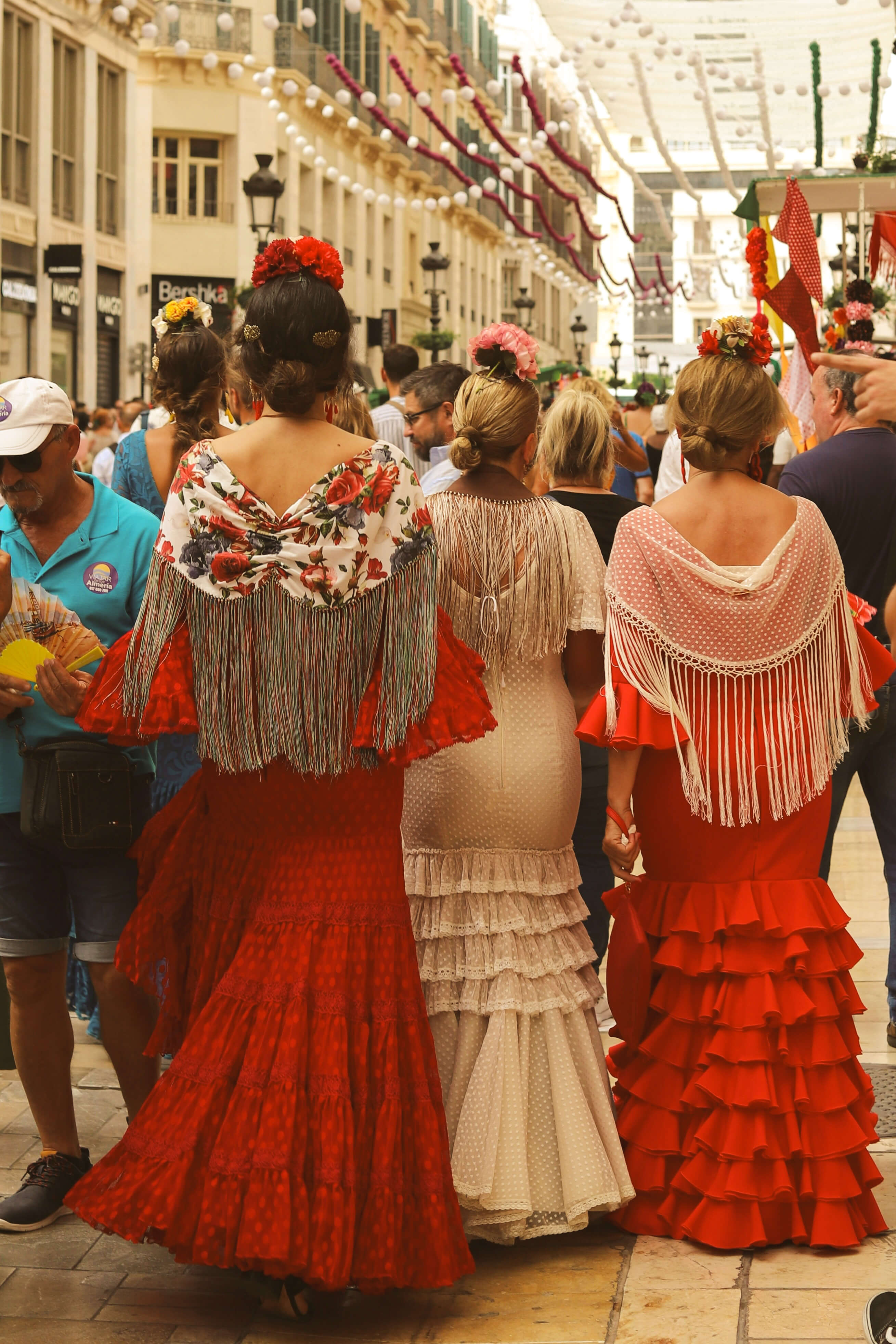
The Feria de Dia takes place in the streets of central Malaga and is in many respects the more accessible and more distinctive of the two feria experiences. From midday onwards, Calle Larios, the city's main pedestrian street, and the Plaza de la Constitucion become the social heart of the celebration, filled with people in traditional dress, live music from charangas and impromptu gatherings, and the particular animated rhythm of an Andalusian city that has given itself formal permission to stop working for a week.
The atmosphere in the day fair is democratic and genuinely mixed. Families with children. Older couples in traditional dress moving between bars. Young groups dancing sevillanas in the street. Tourists watching from cafe terraces. The mix is part of what makes the day fair work: it is not curated for any single audience, and its energy comes from the fact that everyone present is experiencing the same thing in their own way.
The streets are decorated throughout the feria with paper lanterns, coloured bunting, and the particular visual language of Andalusian celebration that transforms familiar urban spaces into something entirely temporary and entirely specific to these eight days. The decoration comes down the moment the feria ends, which is part of its logic: it exists in time rather than in space, and its physical traces are deliberately impermanent.
Food and drink in the day fair are served from the bars and restaurants along the main streets, which extend their terraces and menus to reflect the occasion. The drink of choice is manzanilla, the dry, saline Sherry wine from nearby Sanlucar de Barrameda, consumed in quantities that reflect its status as the default social lubricant of the Andalusian feria. Rebujito, a longer drink made from fino or manzanilla mixed with lemonade or a light mixer, is the alternative for those who want something more manageable across an afternoon. The food is straightforwardly Andalusian: pescaito frito, the lightly battered fried fish that is the region's most reliable pleasure, alongside jamon, salmorejo, and the particular coastal cooking of the Costa del Sol.
The Alcazaba, the Moorish fortress above the city, and the Cathedral are both within easy walking distance of the day fair and worth visiting in the morning before the feria reaches its midday peak. The Picasso Museum, in the Buenavista Palace a short walk from Calle Larios, offers a cultural counterpoint for those who want an hour away from the crowd.
The Night Fair: Cortijo de Torres
The Feria de Noche takes place at the Real de la Feria, a purpose-built fairground at the Cortijo de Torres site on the southern edge of the city, approximately three kilometres from the historic centre. It is reached by shuttle bus from the centre, which runs throughout the evening and into the early hours, and by taxi. The fairground itself is a city within the city: over a hundred casetas arranged along avenues of lights, a funfair with rides of serious scale, food stalls, stages for live performances, and the particular energy of an outdoor celebration that knows it has until dawn to deliver everything it has.
The casetas are the defining element of the night fair and the aspect of the Feria de Malaga most worth understanding before arriving. Each caseta is a large tented pavilion, decorated by its owner and stocked with its own bar and often its own kitchen. Most belong to private groups, family associations, or organisations whose members gather there each feria night to eat, drink, and dance sevillanas. Entry to private casetas requires an invitation from a member, which is less difficult to obtain than it sounds: Malagenos are genuinely generous about extending hospitality to visitors who show genuine interest in the tradition rather than treating it as a spectacle.
The public casetas, run by the city and various commercial operators, are open to all and offer the same experience without the invitation requirement. They tend to be louder and more crowded than the private ones but give an unobstructed view of what the night fair actually is: a collective celebration of considerable scale that manages, through the caseta structure, to feel simultaneously intimate and enormous.
Live music at the night fair ranges from traditional flamenco and sevillanas, performed in and around the casetas, to the larger stages that host popular Spanish artists across the week. The musical programme varies year to year and is worth checking closer to the date. What remains consistent is the sound of the fairground itself: the layered accumulation of dozens of casetas each with their own music, which from the outside produces a particular and unmistakable ambient noise that is unlike anything else in the Spanish summer calendar.
The night fair runs until the early hours every night of the feria. For those who want the full experience, arriving at the fairground around ten in the evening and leaving between two and three in the morning covers the night fair at its most alive without requiring the stamina that a longer stay demands.
Malaga beyond the Feria
Malaga is a city that has undergone a significant transformation in the last two decades. The opening of the Picasso Museum in 2003 began a cultural expansion that has continued with the Pompidou Centre, the Russian Museum, and the Carmen Thyssen Museum, giving the city an arts infrastructure that sits unexpectedly well alongside its coastal tourism identity.
The historic centre, which surrounds the day fair during the feria, is worth time on its own terms. The Alcazaba and the Roman Theatre beneath it occupy the hillside above the port and repay a morning's attention before the heat peaks. The Cathedral, which was left deliberately incomplete in the eighteenth century when funds were diverted to support the American Revolutionary War, has a particular asymmetrical silhouette that makes it one of the more visually interesting Baroque churches in Andalusia. The city is also the birthplace of Picasso, and the house where he was born on Plaza de la Merced is now a small museum that complements the larger collection nearby.
How to approach a visit
The Feria de Malaga rewards a minimum of three nights, which allows for both the day fair and the night fair across multiple evenings and gives enough time for the rhythm of the celebration to settle into something familiar. Two nights is possible but tends to produce the impression of having seen the surface of something rather than having understood it.
The day fair is best experienced in the early afternoon, when the streets are animated but not yet at their peak volume, and again in the early evening when the light is better and the crowd has reached its most convivial density. A quieter period for lunch away from the main streets, then a return for the evening as the day fair transitions toward the night, gives a complete picture of what the day fair is.
The night fair is best approached after nine in the evening, once the fairground has reached its operational rhythm. Arriving earlier means a quieter experience that does not fully reflect what the feria is.
Dress at the Feria de Malaga is a genuine consideration. The traje de flamenca is worn by a significant proportion of women at both the day and night fair, and the traje corto, the short riding jacket and high-waisted trousers of the Andalusian horseman, is worn by many men. Visitors are not expected to dress in traditional costume, but arriving in clothes that reflect some awareness of the occasion reads well in an environment where dress carries genuine meaning. Smart casual at the day fair. Something more considered for the night fair casetas.
Accommodation in Malaga during the feria fills quickly and commands a premium. Booking two to three months in advance is realistic for quality options in the historic centre. For the full official programme, the Ayuntamiento de Malaga publishes all feria details at: www.malaga.eu/feria-de-malaga
What makes the Feria de Malaga worth the journey
The great Andalusian ferias share a quality that is difficult to articulate and impossible to replicate: they are not events that happen in a city, they are events that reveal what a city actually is. For eight days in August, Malaga shows a version of itself that its year-round tourist infrastructure does not. The flamenco dress, the manzanilla, the casetas, the particular sound of sevillanas drifting across a lit fairground at midnight: these are not performances put on for visitors. They are what the city does when it is celebrating itself.
That quality of authenticity, the sense of having encountered something real rather than something staged, is what brings people back to the Feria de Malaga year after year. August in Malaga is worth understanding before you arrive. And it is worth arriving for.

Latest posts

How to design a week in northern Morocco around the 2027 solar eclipse
A week in northern Morocco built around the 2027 solar eclipse combines Tangier, the blue city of Chefchaouen, and Tetouan's UNESCO medina for eclipse day, where four minutes and fifty-three seconds of totality will descend on one of the most culturally extraordinary cities in North Africa.

How to design a week in Andalusia around the 2027 solar eclipse
A week in Andalusia built around the 2027 solar eclipse covers Seville, Ronda, the Sierra de Grazalema, and Marbella for eclipse day, with enough time to experience one of the great destinations in southern Europe alongside one of the most extraordinary astronomical events of a lifetime.

What to know before eclipse day 2027: insider tips for 2 August
The 2027 eclipse is four minutes of totality. The preparation before it determines whether those four minutes are everything they should be. This insider guide covers road closures, booking timing, cloud contingencies, eclipse glasses, and what to expect hour by hour on 2 August.